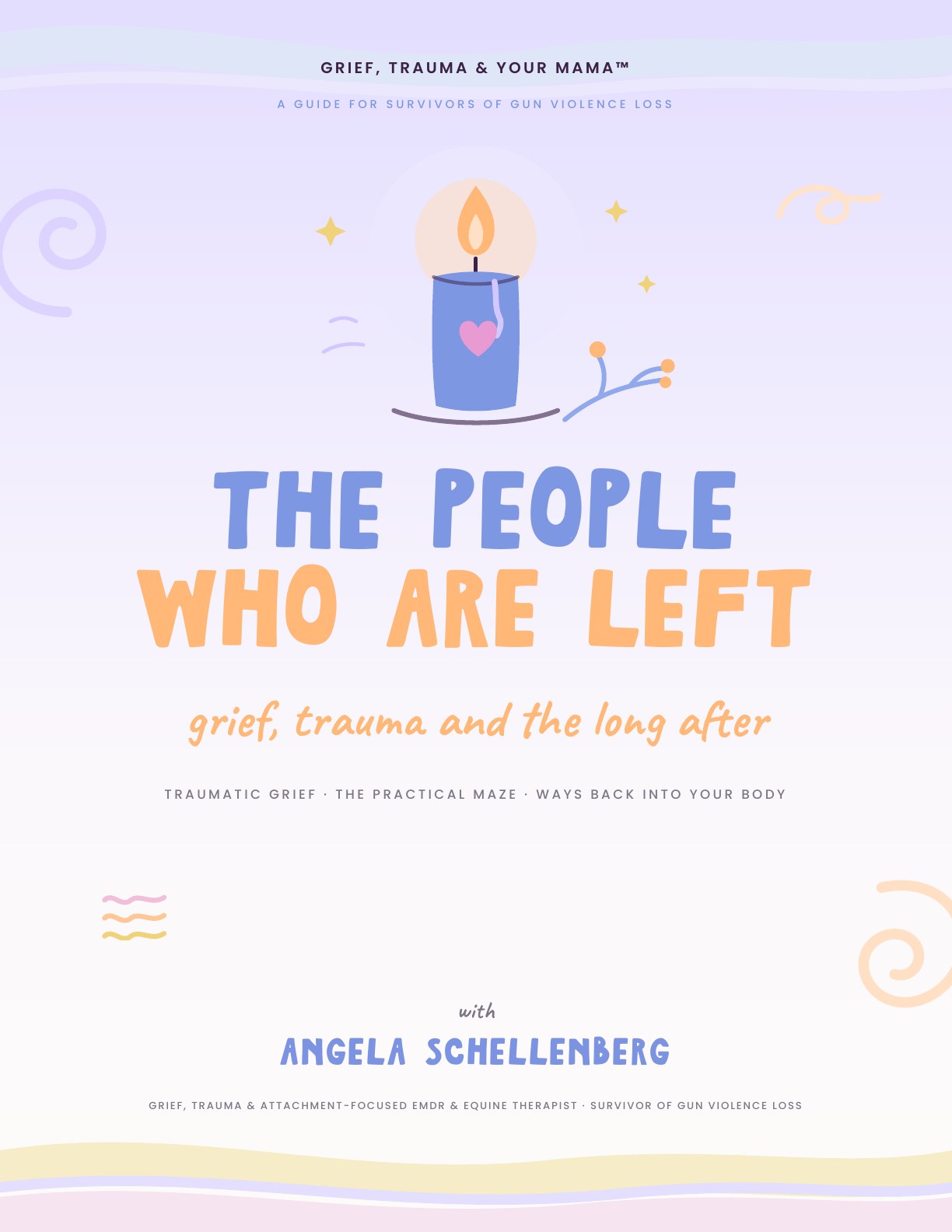
Grief, Trauma & Your Mama™ · A guide for survivors of gun violence loss
The People Who Are Left
Grief, trauma and the long afterSomeone you love died by a gun. A homicide, a mass shooting, domestic violence, a robbery, an accident, or a suicide. Your grief arrived with police, paperwork, and sometimes cameras.
This guide holds both parts: grieving your person, and what the violence left in your body. Open it anywhere. Skip what you are not ready for.
Written by Angela Schellenberg, licensed grief and trauma therapist and survivor of gun violence loss.
Delivered to your inbox in a minute or two. Questions? Ask Angela.
If you are in crisis right now: call or text 988, the Suicide & Crisis Lifeline, any hour in the US. You can also text HOME to 741741. If you have a plan, or you are in danger, call 911 or go to your nearest emergency room. Outside the US, contact your local emergency number.
You are grieving a person, and you are carrying what happened to them. Both deserve care.
what is happening in you
Grief and trauma, tangled together
People who lose someone to gun violence often say the same thing in the first months: I think I am losing my mind. What they are carrying is two things at once.
One is grief: the longing, the missing, the search for a person who is gone. The other is trauma: the shock of how they died, the phone call or the knock at the door. Clinicians call this traumatic grief, and each part makes the other harder to move through.
Images that arrive on their own, startling at a car backfiring, rage that surprises you and numbness that surprises you more. These are what a nervous system does when it has taken in something it had no way to prepare for.
why I wrote this
The guide I wish my family had
I lost my father to gun violence in 1988. I have been a survivor of this kind of loss for most of my life, and I know how it tangles with shock, with anger, and with a story that was cut off.
I trained in Restorative Retelling with Dr. Ted Rynearson, who built a therapy for people bereaved by violent death, and I contributed to From Healing to Action, the survivor toolkit from GIFFORDS and Survivors Empowered. This is the guide I wish someone had handed my family.
what’s inside
Thirty-two pages to open anywhere
Short pages to read, pages to write in, and lists you can hand to the people around you. Nothing has to be done in order, and nothing has to be finished.
- Traumatic grief, and what your body is doing
- No goodbye: the story that was cut off
- A page for when it was suicide
- The first days, and seeing your person
- Police and the medical examiner: questions you can ask
- Victim advocates and help with costs
- If there is a court case, and a victim impact statement
- When it was public: reporters, and after a mass shooting
- Social media, strangers and fake fundraisers
- Anger, justice and forgiveness
- Siblings, and talking with children
- The dates that come back, and another shooting in the news
- Ways back into your body, and a steadying plan
- Survivor communities and crisis lines, each with a QR code
get the guide
Yours in a minute or two
The People Who Are Left
32-page PDF
- The full 32-page guide
- Print at home or write in it on a tablet
- Delivered to your inbox right after checkout
questions
Before you buy
Who is it for?
Anyone whose person died by a gun: a homicide, a mass shooting, domestic violence, a robbery, an accident, or a suicide. Some people also send it to a friend or family member in the weeks after.
Does it give legal advice?
No. The practical pages (police, the medical examiner, advocates, court) stay general on purpose, because the rules differ by state. They help you know what to ask and who can help you.
How do I get it?
Instantly, by email. As soon as checkout finishes, a download link arrives in your inbox. Save the file once it opens.
Is it a printed book?
It is a PDF. Print it at home, or open it on a tablet and write in it with a stylus. It is US letter size.
Is it therapy?
It is an educational guide for personal reflection. If you want a therapist, it has a page on when to reach for more support.
What if I am in crisis?
Call or text 988, the Suicide & Crisis Lifeline, any hour in the US. Text HOME to 741741 to reach a trained crisis counselor. If you have a plan, or you are in danger, call 911 or go to your nearest emergency room. Outside the US, contact your local emergency number.
Can I get a refund?
Because it is an instant digital download, all sales are final. If the file will not open or something goes wrong, email me and I will send it to you personally.
Want a person with you?
Some weeks a guide is enough. Some weeks you want someone with you. There is a free fifteen-minute call, if you want it. You can also find survivor organizations on my gun violence survivors page.
Book a free 15-minute call