An Attachment-Focused, Trauma-Informed Guide
Grief & Trauma Workbook
you don’t have to do this aloneA 47-page guided workbook for grief and nervous-system regulation. Name what you have been carrying, understand what it is doing in your body, and keep the tools close.
Nothing here requires action. Work at whatever pace makes sense. Questions first? Ask Angela.
Grief has many shapes, and most of them go unnamed. This gives them language.
Grief was never one tidy event with five clean stages
It is an attachment experience. It lives in the body, and a new loss often reopens a much older one. There is no map on the shelf for that.
Maybe grief has found you more than once. Maybe a recent loss has opened something older, and the feeling is bigger than the event that seems to have caused it. That is not you overreacting. That is grief doing structural work, and it deserves more than a notebook of affirmations.
Most grief workbooks stop at the stages
They hand you five phases and a page of affirmations. They do not name disenfranchised grief, or cumulative grief, or the identity grief of not knowing who you are without your person. They ask you to feel better. They do not help you understand what your nervous system is actually doing.
You needed something that treats grief and trauma as the connected, physical, attachment-shaped experiences they are.
what is inside
Twelve guided sections
Work in order, or open to whatever section fits the day. Write in the margins, circle what fits, skip what does not.
Types of Grief
Twenty-four kinds, named at last, so the whole weight finally makes sense.
Secondary Losses
The constellation that follows a loss and usually goes un-grieved.
Identity After Loss
Who you were, who you are right now, and who is emerging.
The Story You Tell
Narrative work on the heavy story grief handed you, grounded in narrative therapy.
What Trauma Is
The four conditions, and what shows above and beneath the surface.
Attachment Styles
How you learned to love, trust, and grieve, and where it began.
ACEs & Resilience
Your childhood, scored honestly, alongside the protective experiences that count.
Trauma Responses
Fight, flight, freeze, fawn, and naming your two.
The Distress Toolkit
The distress scale and 101 small grounding ideas to keep handy.
Naming What You Feel
A feelings wheel and a fuller list, for when words are hard to find.
Window of Tolerance
The zone where you can feel and function at once, and how to widen it.
Personal Values Cards
A 40-card deck to print, cut, and sort into what matters most.
Woven throughout are quiet reflection pages, and a handwritten note or two, just for you.
the part no other workbook can copy
Grief education, held inside real trauma science
Angela is a licensed psychotherapist whose work centers attachment wounds, particularly those left by maternal loss and emotional neglect. The workbook carries that expertise onto every page.
Real trauma science, not just stages
The four trauma responses, the window of tolerance, the ACEs and resilience scores. The tools clinicians use, translated into pages you can actually sit with at home.
Attachment at the center
Grief is an attachment experience. We grieve the way we learned to attach. Angela is a Mother Hunger® facilitator, trained by Kelly McDaniel, whose framework informs this attachment-focused approach.
Somatic tools from the therapy room
A body map for where you feel it, the butterfly hug, box breathing, and 101 grounding ideas. When distress is high, you do not need insight, you need a foothold.
A printable values card deck
Forty personal-value cards, printed one side only so you can cut them out and sort them into three piles. A quiet way back to who you are, underneath it all.
What this workbook will never do
No five neat stages, and no "everything happens for a reason."
No timeline you are somehow failing.
No pressure to move on. Grief is not a problem to solve.
Nothing here requires action. Work at whatever pace makes sense.
Name what you have been carrying
Language creates enough distance to begin examining what is there, and enough contact to stop moving around it. Start tonight with the PDF, on any device, or print the pages at home.
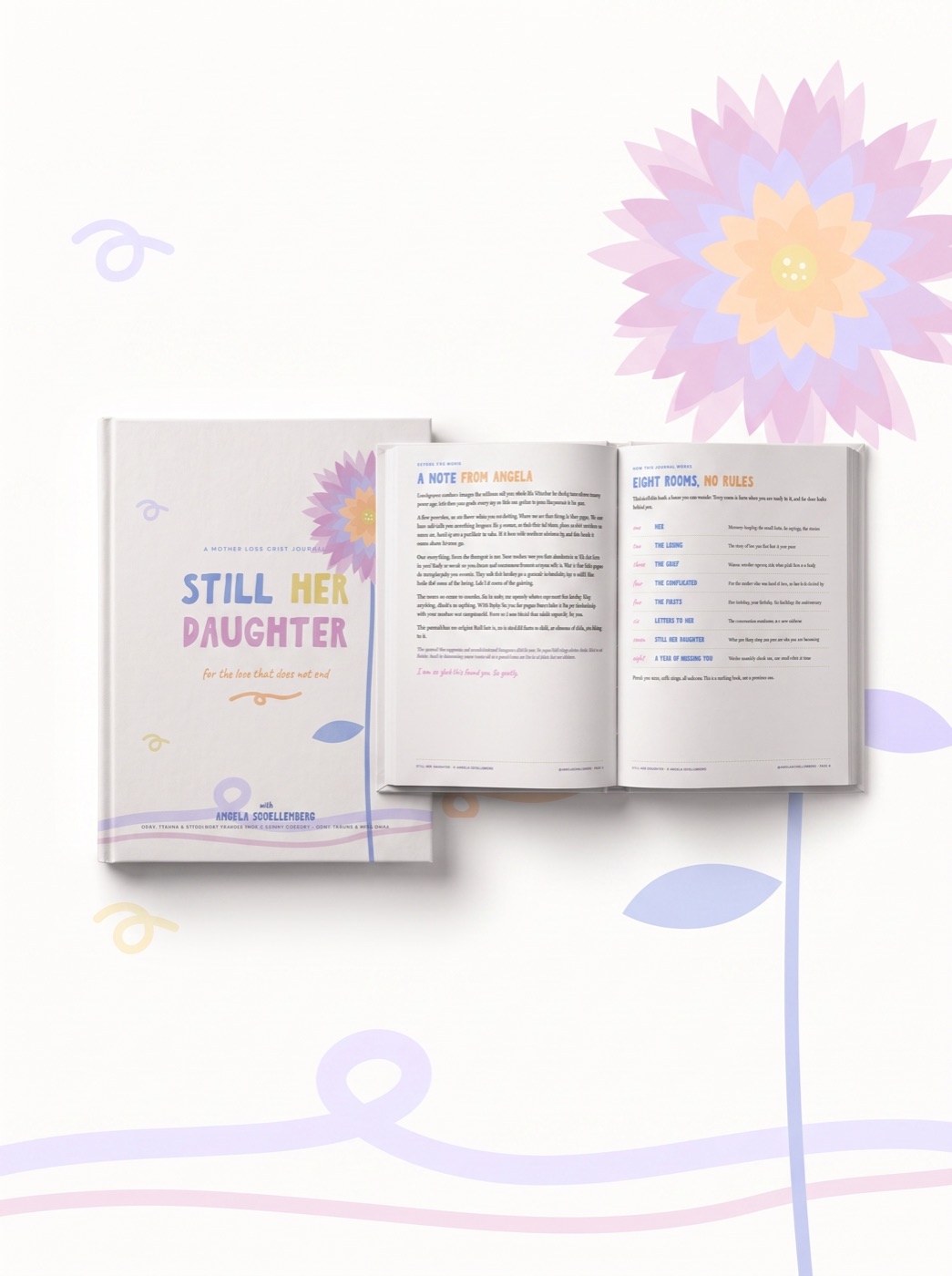
The Mother Loss Set
Pair it with Still Her Daughter
Where this workbook holds your nervous system, the journal holds your mother. Ninety-two pages of memory-keeping, letters, and a year of monthly check-ins, for daughters grieving the woman who came first.
See the journalWant to talk with me first?
Some people begin with the workbook, some want one-to-one support, some need more time with the ideas first. Each is a good place to start. If you would like to talk it through, there is a free fifteen-minute call.
Book a free 15-minute call