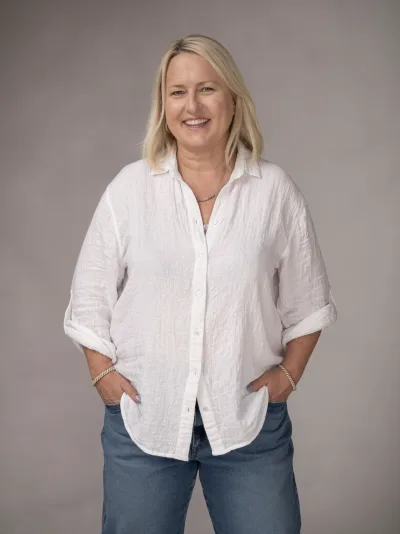
Angela Schellenberg
Most grief directories do not name mother loss as its own category, so your body keeps scanning the page for proof that what you are considering was built for what you are actually carrying. You are not stalling. You are not being difficult. Your nervous system is doing the only thing it knows to do: wait for evidence before it risks reaching.
A note on credit: Mother Hunger® is a term and framework created by therapist Kelly McDaniel, author of Mother Hunger® (2021). This article explains her concept in my own words. Learn more at kellymcdaniel.com.
Why does every grief resource in LA feel like it was written for someone else?
Because most grief resources were not written for mother loss specifically, and your body knows the difference before your mind finishes reading the page.
You open a therapy directory on a Tuesday night. You scroll through grief specialists. You read intake forms that ask whether you are experiencing a recent loss, a traumatic loss, complicated grief, or anticipatory grief. Not one checkbox says: I lost my mother and the ground has not felt solid since, and I do not know whether what I am carrying is grief or something older that her death just cracked open.
That is not a failure of the directories. They sort people into categories that fit on one line. Mother loss does not fit on one line. It is not simply the death of a person you loved. It is the loss of the original source of safety, the person the nervous system organized itself around from its first hours. When that loss gets filed under "recent bereavement" or "life transition," something in you quietly closes the tab.
You are not being too particular. Below the level of words, you are recognizing that what you are grieving requires someone who understands what it actually is. The problem is that most of what surfaces in a search does not tell you, clearly enough for your body to believe it, that the person on the other end of the intake form has met this specific wound before.
Why does researching grief support feel like a second job that never leads anywhere?
Because the body is not looking for a good therapist in general. It is looking for evidence that care was built for the specific grief it is carrying, and that evidence is rarely stated clearly enough to land.
Here is what the research cycle looks like for many of the daughters I work with. They spend an evening reading therapist bios, save a few websites, return to them three days later, read them again, and feel the same uncertain flatness. They add a retreat to a wishlist. They close the laptop. They wake up the next morning and wonder if they are the problem.
They are not the problem. The body is doing something very specific: scanning for proof that the support being offered was designed for the grief it is carrying, and not finding that proof stated clearly enough to trust. This is not paranoia. This is the attachment system, which has likely been navigating uncertainty about whether care is really available for a long time, doing what it has always done. Looking for evidence before it risks reaching.
Kelly McDaniel describes this pattern in her framework Mother Hunger®, which identifies how daughters who did not receive consistent nurturing, protection, or guidance from their mothers often develop a deep ambivalence about reaching for care at all. The wound and the hunger coexist. The woman wants support and does not fully trust that it is hers to have. That ambivalence is not a mood. It is a structure built over years, and it does not dissolve because a website looks professional.
What is the body actually waiting for when it keeps stalling on booking grief support?
It is waiting for specificity: not inspiration, not warmth, but language that names the actual shape of what was lost.
There is a difference between a grief therapist who treats loss and a grief therapist who names mother loss as a distinct attachment wound requiring its own clinical approach. There is a difference between a grief retreat that promises transformation and one that says: we know that some of the women who arrive here are not just sad about a death. They are grieving a relationship that was complicated, or incomplete, or that ended before they ever got what they needed from it. Both kinds of grief belong here.
When a daughter who has lost her mother reads something that specific, something shifts in the body before the mind has fully processed the words. That is neuroception at work, the nervous system's unconscious scanning for whether an environment is safe, a concept developed by researcher Stephen Porges. The body reads the language, the tone, the precision of what is being offered, and makes a determination: is this a place where my actual grief, not a tidier version of it, will be welcome.
Most directories do not pass that scan. Not because they are bad, but because they are not specific enough to register as safe for the particular thing she is carrying.
Why does mother loss not appear clearly in grief support descriptions?
Mother loss does not have its own checkbox because the mental health field has historically treated it as a subset of bereavement rather than a distinct attachment wound with its own clinical structure.
The assumption embedded in most intake language is that grief is grief: you lost someone, you are sad, you need processing and support and eventually you will feel better.
That framework misses something fundamental. The mother is not simply a person who was lost. She is, for better or worse, the original attachment figure. The nervous system organized itself around her presence before the child had any language or choice about it. Losing her, whether through death, illness, emotional unavailability, or estrangement, does not produce ordinary grief. It produces a rupture at the level of the body's foundational architecture.
When a grief support program does not name that distinction, when it groups mother loss with job loss and divorce under the umbrella of major life changes, the daughter reading the description feels nothing she can hold onto. She moves on. She tells herself she will find something later. Later becomes months.
What should grief support for mother loss in LA actually look like?
It should name the wound clearly, near the beginning of what it offers, and it should address the attachment layer, not just the loss event.
It should say, somewhere near the top, that mother loss is an attachment wound, that it reaches back further than the death or the estrangement, that the grief inside it often includes mourning a mother who was still alive: mourning who she could not be, mourning the childhood built around a presence that was not reliable enough or simply not there.
It should have a structure that accounts for the fact that the nervous system cannot release this kind of grief in a fifty-minute session once a week. Research on prolonged grief, documented by Boelen and colleagues in 2022, consistently shows that grief tied to insecure attachment histories is more intense, more prolonged, and more likely to remain unresolved without an approach that specifically addresses the attachment layer. A weekly check-in does not reliably reach that layer.
It should also work with the body. Not because talk therapy is useless, but because the part of the loss that lives in the nervous system, in the places that braced when she called and hollowed out when she did not, is not accessible through narrative alone. Approaches that engage the body directly, including EMDR intensives and equine-assisted work, are structured to reach what conversation alone cannot.
The EMDR intensives I offer are designed specifically for attachment grief, including mother loss. The equine-assisted retreats at Shakti Ranch in Malibu were built for daughters who have been researching grief support for months without finding anything that felt like it was for them, because I have met enough of those daughters to know that the gap between knowing you need something and believing it exists for you is real, and it deserves a direct answer.
If you live in LA and lost your mom, where do you actually start?
You start by recognizing that the months of searching were not wasted. You were not procrastinating. You were looking for something specific enough for your body to trust.
Then you look for providers who name mother loss, attachment grief, or complicated maternal grief explicitly in how they describe their work. If a bio or program description says nothing that signals the person on the other end understands the specific shape of this wound, that is useful information. Not a reason to give up. A reason to keep looking.
Ask specific questions before you book anything. Ask whether the therapist or facilitator has worked with daughters who have lost mothers. Ask whether their approach addresses attachment alongside grief. Ask what the format looks like and whether body-based work is part of it. What comes back will tell you more than any credential listing.
And if what finally lands for you is a retreat or an intensive rather than weekly therapy, that is not an indulgence. It is the nervous system correctly identifying that it needs more than a sliver of time to move what it has been carrying. Four days in a different environment, with sustained focus on this specific wound, reaches a different layer than an hour a week inside the same life that contains everything else.
There are good options in LA, and some of them were built for exactly what you are carrying. The months it has taken to find something that feels right are not a reflection of your resolve. They are a reflection of how invisible mother loss has been in most of what calls itself grief support. That invisibility is worth naming, and you have already named it by knowing that what you found so far was not quite right.
References: Boelen, P.A. et al. (2022). Prolonged grief disorder and attachment: findings on intensity and duration. Kelly McDaniel, Mother Hunger® (2021). Stephen Porges, neuroception and the Polyvagal Theory (referenced in context of unconscious safety scanning).
Frequently asked questions
Why do grief support programs in LA not specifically mention mother loss?
Most grief programs are built around general bereavement frameworks that treat all loss as belonging to the same category. Mother loss is an attachment wound with a distinct psychological structure, and most intake systems were not designed to name that distinction. This leaves daughters scanning for a match they rarely find in standard program descriptions.
Is it normal to research grief support for months without booking anything?
It is more common than most people admit, and it is not a sign of avoidance. The body is scanning for evidence that the support being offered was built for the specific kind of grief it is carrying. When that evidence is absent from program descriptions and intake forms, the nervous system waits rather than risks reaching toward care that does not feel like it fits.
What kind of grief support is designed specifically for daughters who have lost their mothers?
Look for providers who name mother loss or attachment grief explicitly in how they describe their work. Approaches that combine EMDR with attachment-focused therapy, or that include body-based work alongside talk, are better structured to reach the layer of grief that lives below language. Retreat formats that create sustained environmental safety over several days allow the nervous system to shift in ways that weekly sessions often cannot.
What is Mother Hunger and how does it relate to grief after losing a mom?
Mother Hunger is a framework developed by therapist Kelly McDaniel that describes the longing daughters carry when they did not receive consistent nurturing, protection, or guidance from their mothers. It helps explain why daughters often feel ambivalent about reaching for grief support at all: the hunger for care and the distrust that care is available exist at the same time. When a mother dies, that ambivalence does not disappear. It becomes part of the grief.
Does Angela Schellenberg work with daughters grieving their mothers in the Los Angeles area?
Yes. Angela is a licensed trauma and grief therapist based in California who works specifically with attachment grief and mother loss. She offers EMDR intensives and equine-assisted retreats at Shakti Ranch in Malibu, and she is a trained Mother Hunger® Facilitator, having trained with Kelly McDaniel, the framework's creator. Her work is structured specifically for the kind of grief that most directories do not have a name for.
Keep reading
Why does fall feel so heavy before the holidays have even started?
Why do I feel like I never got to grieve? I was too busy handling everything.
Why can't I cry even when I'm completely alone? Why won't my grief come out?
Something to write in
Still Her Daughter
A guided journal for daughters after mother loss, written to be used at whatever pace makes sense.
Read more · $14.99
Angela Schellenberg
Angela is a licensed trauma and grief therapist, attachment-focused EMDR specialist, and trained Mother Hunger® Facilitator (a framework created by Kelly McDaniel). She hosts the Grief, Trauma & Your Mama podcast and leads Equine Resourcing Intensives and equine-assisted retreats at Shakti Ranch in Malibu. Licensed in California, Washington, and Arizona. Work with Angela →