A Sudden Loss Grief Journal
No Goodbye
for the love that got no warningAn 82-page guided journal for people who lost someone without warning. Seven rooms you can move through at your own pace, written by a licensed grief and trauma therapist.
Grief is love with nowhere obvious to go. This gives it somewhere to go. Questions first? Ask Angela.
They were here, and then they were not, and there was no space in between.
You did not get to say the thing
So the conversation never closed. It keeps running, sometimes for decades, at three in the morning when there is nobody to call.
When a death is sudden, grief and shock begin in the same moment. There was no rehearsal. Your mind did not get to practise. So it practises now, afterward, running the day again and again, looking for the exit you missed. This is a mind doing what minds do when something arrives faster than they can take it in.
Most grief journals assume you got to say goodbye
The ones you find are thin notebooks with fifty one-line prompts and a sympathy-card voice. They have no room for the last ordinary text, the moment you found out, the images that arrive on their own, or the if-onlys that run all night.
Sudden loss is its own country, and grief and trauma travel through it together. You needed a place built for that, one that could hold the whole of them and the whole of the day, without asking you to tidy any of it up.
what this actually is
Seven rooms you can move through, at your pace
Think of the book as a house. Every room is here when you are ready for it, and no door locks behind you. Room three holds the day itself, and every page in it is optional.
Who They Were
The person, before the way they died took the microphone.
The Last Ordinary Day
The last text, the last call, the ordinary you did not know to keep.
The Day I Found Out
Gated, optional, and yours to open only when you choose.
Your Body
Sleep, appetite, the three a.m. of it, and what actually helps.
The If Onlys
The replaying, the blame, and the conversation you never finished.
The World After
What people said, who stayed, and everything else this took.
Carrying Them
Keeping them with you without keeping the worst day with you.
Pencil, pen, tears, coffee rings. All welcome. This is a working book, not a precious one.
the part no other journal can copy
Written by a therapist who works with this exact grief
Angela is a licensed grief and trauma therapist. So the book holds what other journals cannot.
A room for the day itself, with a door you control
The day you found out has its own room, and it is gated on purpose: pick your time, pick your exit, set a limit. Every page inside it is optional, and it closes with a page that helps you put yourself back down.
The difference between grief and trauma
Remembering has a past tense. An intrusive memory arrives in the present tense, with the body reacting as though it were happening now. The journal names that difference plainly, because grief needs witnessing and time, and trauma needs treatment.
Somatic practices from the therapy room
These pages do not only ask you to write. There is a traceable box-breathing square, a six-fast-ones page for when it comes up quickly, and 101 ways to steady a nervous system at the back. Use them before a hard page, after a hard page, or instead of one.
A door to more, on the last page
When you finish your last letter to them and turn the page, there is a way to reach Angela directly, including a free fifteen-minute call, for the days a book is not quite enough.
What these pages will never do
No silver linings, and no "everything happens for a reason."
No timeline you are somehow failing.
No religion built in, so it holds whatever faith, or absence of faith, you bring.
No pressure to be done. Grief is not a problem to solve.
Give the love somewhere to go
Start tonight with the instant PDF. It will wait for you on the hard days and keep your words on the good ones, and there is no deadline anywhere inside it.
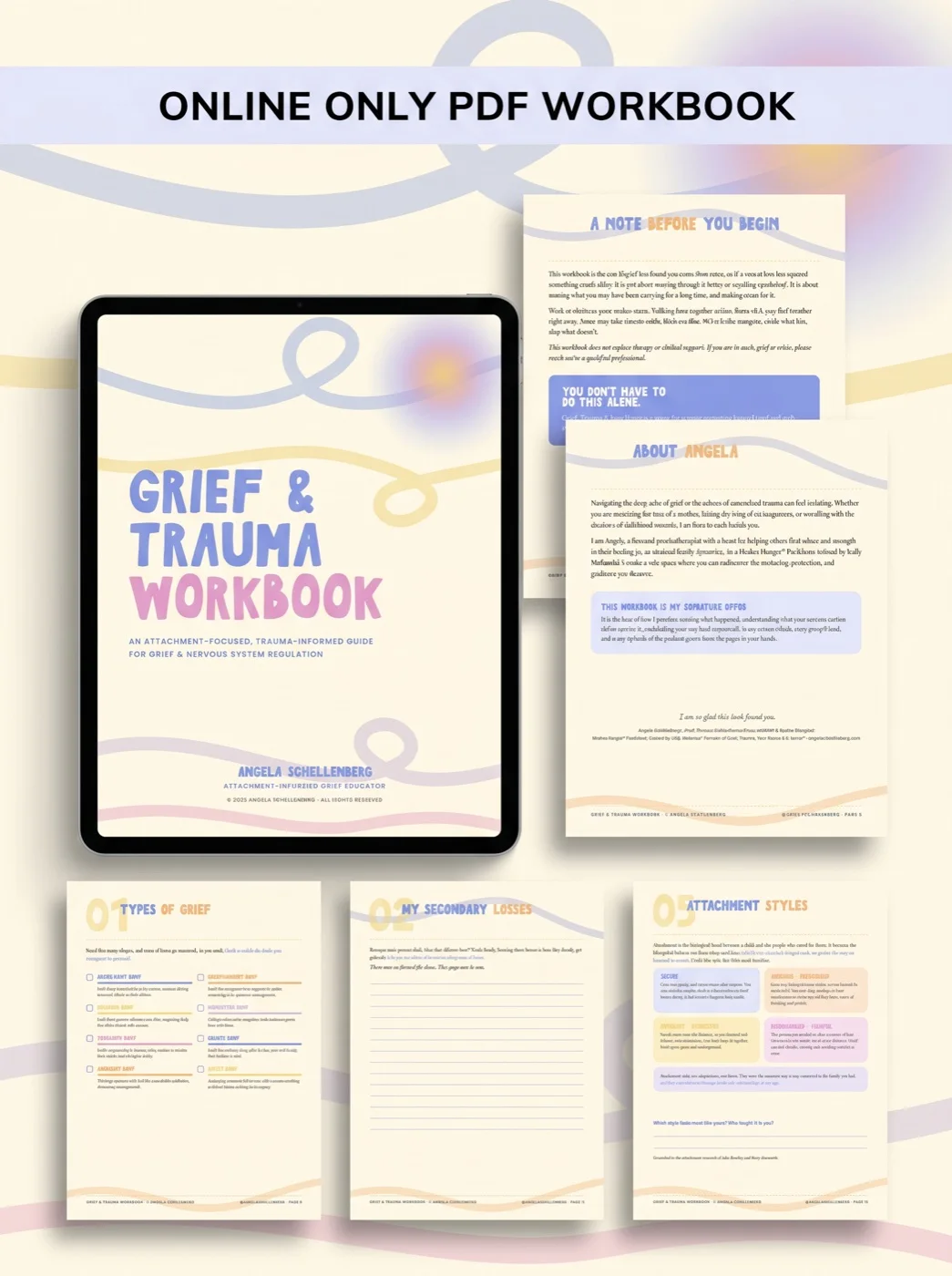
They belong together
Pair it with the Grief & Trauma Workbook
Where this journal holds the person you lost, the workbook holds your nervous system. Twenty-four kinds of grief, your attachment style, your trauma responses, and a printable values card deck. Many readers keep both on the nightstand.
See the workbookNot sure where to begin?
Some women start in community, some want focused one-to-one support, some just need more time with the pages first. None of those are wrong. There is a free fifteen-minute call, if you want it.
Book a free 15-minute call