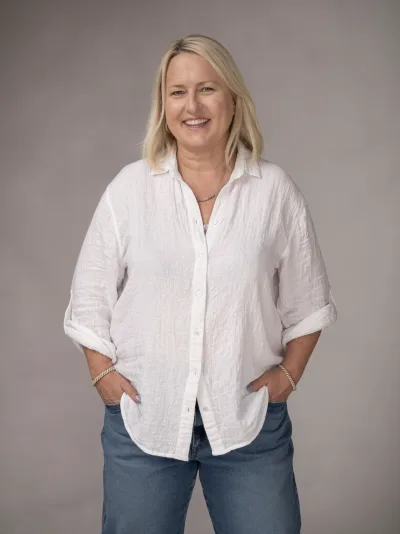
Angela Schellenberg
Equine-assisted EMDR brings horses into EMDR therapy, most often during the resourcing phase, where the nervous system builds calm and safety before any memory work. With me, the horses support resourcing on the ground at Shakti Ranch in Malibu, and the EMDR reprocessing itself happens in online one-on-one sessions.
What does equine-assisted EMDR mean?
It is a broad name for EMDR work that includes horses. Practitioners use it in different ways. Some bring horses into the full EMDR protocol. Others, like me, bring horses into one part of it: the preparation and resourcing phase, where your body learns what calm and support actually feel like before you go anywhere near a hard memory.
Because the term covers different methods, it is worth asking any provider exactly which parts of the work happen with the horses, who is licensed, and where the memory reprocessing takes place.
Why horses?
Horses are prey animals. Their survival depends on reading the nervous systems around them, so they respond honestly to what you are feeling, even when you are not saying it. Many women who come to this work are tired of explaining their grief. Horses do not need the explanation.
Being near a calm herd invites co-regulation, where your body borrows their steadiness and slowly learns that it is safe to settle. That is the same thing EMDR resourcing is trying to build. With the horses beside you, a Peaceful Place or a protective figure can become something your body has felt, not only something you imagined.
If you have ever cried near a horse when you could not cry in therapy, you are not alone. I wrote about that in Why can’t I cry in therapy, but I cry near a horse?
How is this different from EquiLateral or other equine EMDR protocols?
EquiLateral is an equine-assisted EMDR protocol that brings horse experiences into the standard eight-phase EMDR protocol. It has been written about in research journals, and it is one of the better-known names in this space.
My work is different in two ways. First, I work in Attachment-Focused EMDR, the model developed by Laurel Parnell, which is gentler, more relational, and built for wounds that formed inside relationships, like mother loss and early attachment injuries. Second, I keep the roles clear. The day with the horses is resourcing. The reprocessing of specific memories happens online, one to one, where we can pace it carefully and close each session in a settled state.
What happens on a day with the horses?
The Equine Resourcing Intensive is a full Monday at Shakti Ranch in the hills above Malibu, from 10am to 3pm. It starts with a 30-minute intake call before your day. Then two hours with the herd, lunch on the coast, and two more hours with the herd. A 60-minute integration session on Zoom follows one to two weeks later.
There is no riding. Everything happens on the ground, at your pace. You do not need any horse experience, and fear of horses is welcome. You decide how close you want to be. The day is somatic resourcing and coaching, not therapy or treatment, and it costs $4,000, cash-pay.
Who is equine-assisted EMDR for?
Most equine programs online are built for children, veterans or addiction treatment. This work is for adult women carrying grief, mother loss, sudden loss, or attachment wounds. It tends to suit women who have already done a lot of talk therapy and understand their story well, but whose body has not caught up. Insight is there. Settling is not.
It can also help when grief will not come at all. If you are numb, if you cannot cry, or if your system goes quiet the moment you try to feel, ground-based time with the herd can open a door that talking keeps closed. If you are drawn to horses without knowing why, this piece may speak to you.
Is there research on EMDR with horses?
Research on equine-assisted EMDR is early and small. There are published case studies and pilot studies, including work on the EquiLateral protocol for PTSD, but nothing yet at the scale of the research behind EMDR itself. EMDR is one of the most studied trauma therapies in the world. Equine-assisted approaches are newer, and anyone who tells you the evidence is settled is overselling.
What I can tell you is what I see. When the resources that EMDR depends on are built with a living, breathing animal beside you, they tend to feel more real and more available later, when the harder work begins.
How do I start?
Online Attachment-Focused EMDR sessions are for clients located in California, Washington, Arizona or Florida, and are described on the EMDR page. The horse day is in Malibu, on Mondays only. You can do one, the other, or both. If you are not sure which fits, start with a free 15-minute conversation. I will tell you honestly whether this is the right door, and it is okay if the answer is not yet.
Frequently asked questions
What is equine-assisted EMDR?
Equine-assisted EMDR brings horses into EMDR therapy, most often during the resourcing phase, where the body builds calm and safety before memory work begins. With Angela, the horses support resourcing on the ground at Shakti Ranch in Malibu, and EMDR reprocessing happens in online one-on-one sessions.
Do you ride the horses in equine EMDR?
Not in Angela's work. Everything happens on the ground, at your pace, with no riding and no horse experience needed. Fear of horses is welcome, and you decide how close you want to be.
Where can I do EMDR with horses near Los Angeles?
Angela offers the Equine Resourcing Intensive at Shakti Ranch in the Santa Monica Mountains above Malibu, about an hour from Santa Monica and Los Angeles. It runs on Mondays from 10am to 3pm and includes a 30-minute intake call, lunch on the coast, and a 60-minute Zoom integration session afterwards. It is $4,000, cash-pay.
Is equine-assisted EMDR the same as EquiLateral?
No. EquiLateral is one specific equine-assisted EMDR protocol built on standard EMDR. Angela works in Attachment-Focused EMDR, the Laurel Parnell model, and uses the horses for resourcing, while reprocessing happens in online sessions.
Is the horse day therapy?
The Equine Resourcing Intensive is somatic resourcing and coaching, not therapy or treatment, even though Angela is a licensed trauma therapist. It complements ongoing therapy, with Angela or with another therapist, and does not replace it.
Keep reading
Grief work with horses in Malibu: the Equine Resourcing Intensive
Working together
Attachment-Focused EMDR for grief
Sixty-minute virtual sessions for clients in California, Washington, Arizona, and Florida. Single sessions are $350, with packages of three ($1,050), six ($2,100), and ten ($3,500). Paced for grief, with resources built before any memory work.
Angela Schellenberg
Angela is a licensed trauma and grief therapist, attachment-focused EMDR specialist, and trained Mother Hunger® Facilitator (a framework created by Kelly McDaniel). She hosts the Grief, Trauma & Your Mama™ podcast and leads Equine Resourcing Intensives and equine-assisted retreats at Shakti Ranch in Malibu. Licensed in California, Washington, Arizona, and Florida. Work with Angela →