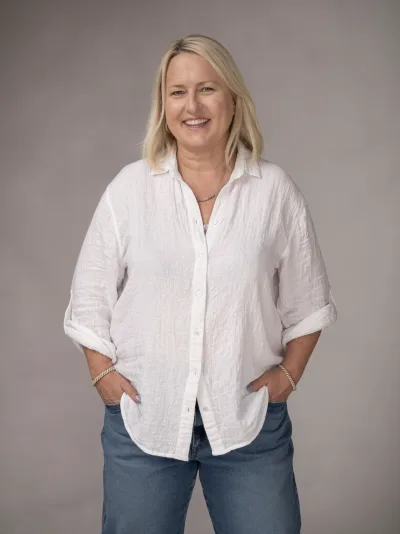
Angela Schellenberg
Horses help with grief when therapy hasn't worked because they respond directly to your nervous system, not to what you say or how composed you appear. Your body broadcasts the attachment grief you have never spoken aloud, and the horse feels it. That physiological honesty, met with steady, non-judgmental presence, unlocks something language rarely can.
Why do women cry beside a horse before they have said a single word?
She has sat across from a therapist for two years without crying once. She is articulate, composed, fluent in the clinical vocabulary for what she carries. She can name her attachment style. She can describe the loss in clean, organized sentences. And then she walks up to a horse at Shakti Ranch and she is crying before she has taken a breath to speak.
This is not magic. It is biology.
The horse is not reading her face. It is reading her nervous system: her heart rate variability, the micro-tension locked in her shoulders, the breath sitting too high in her chest since the moment she got the phone call, the diagnosis, the silence that finally confirmed what she had feared for years. The horse receives the signal her body is sending. It responds to that signal, not to her presentation.
That is the moment the grief moves. Not because something comforting was said. Because something true was finally felt by another living being, and that living being stayed anyway.
What does a horse actually feel that a therapist cannot?
A horse receives your nervous system's broadcast directly, without filtering it through language, and that is something no human clinician can structurally replicate. Your therapist is listening to language. Her attunement is real, her skill genuine, but she is working with what you give her in words. And words are managed. Even when you are trying to be honest in a therapy office, you are still selecting, sequencing, organizing what you share. That selection process lives in the prefrontal cortex. The grief that has not healed usually does not live there.
Attachment grief, the kind that forms when you lose a primary person, or when a primary person was never quite fully there, lives in older subcortical structures. It lives in the body's threat-detection system, in the places that learned, before you had language, whether reaching for someone was safe or dangerous. You cannot narrate your way into those places. They do not respond to explanation. They respond to experience.
Horses are prey animals whose survival depends on reading the emotional state of every being in their environment. They are, by nature, nervous system translators. Not performing empathy: doing what evolution built them to do, which is sense threat, tension, or safety in the body of whatever is standing near them. When your nervous system is broadcasting grief, a horse receives that broadcast without asking you to make it legible, without needing it to make sense.
That is not a failure of therapy. It is a structural limitation of how human conversation works, and why equine work reaches something else entirely.
Why does attachment grief specifically need the body to heal?
Attachment grief requires body-level healing because it lives below thought, in the nervous system's ongoing search for the person whose presence once organized it. Your mother. Your partner. The person you reached for first when something went wrong. When that person is gone, or when you are finally reckoning with the fact that they were never quite there in the way you needed, the nervous system does not simply feel sad. It enters a search state. It keeps reaching. It keeps scanning for the presence it cannot yet metabolize.
That search happens below thought. It happens in the body. And because it happens below thought, thinking about it, talking about it, even understanding it clearly in a therapy office, does not always stop the search. The body needs a different kind of experience. It needs to be met by something living, present, and regulated, so the nervous system can begin to learn, slowly and at its own pace, that it is possible to be felt without being abandoned, to be seen without being hurt.
Stephen Porges, whose Polyvagal Theory maps exactly this kind of nervous system communication, describes how mammals regulate one another's autonomic state through proximity, rhythm, and co-presence, not through words. Horses offer a form of co-regulation that is primal in the most precise sense of that word. It reaches the part of the nervous system that formed before speech, the part that still holds what happened before you had words for it.
Why is the Shakti Ranch retreat different from a wellness experience?
The Shakti Ranch retreat is clinically structured, not wellness-formatted, which is why National Geographic included it among the best grief retreats and not among spa escapes. The mornings are clinical: psychoeducation around grief, trauma, and attachment, emotional regulation tools, distress tolerance. This is not journaling and intention-setting. It is education led by Angela Schellenberg, a licensed trauma and grief therapist and attachment-focused EMDR specialist with over ten years of experience, alongside Claire Bidwell Smith. Women arrive understanding, sometimes for the first time, what their nervous system has actually been doing and why.
The afternoons move to Shakti Ranch with the horses. What happens there is not therapeutic horseback riding. It is equine-assisted grief work, and the distinction matters. You are not learning to ride. You are standing in proximity to an animal that will feel what you have not said, and respond to it. The session might last twenty minutes before something shifts that two years of weekly sessions has not touched.
A sound bath. Yoga. A long table of food prepared by a private chef. Three nights on a Malibu hilltop with women who understand what you are carrying because they are carrying a version of it too. The retreat is not asking you to feel better by Friday. It is offering your body a different kind of experience so that something can begin.
The Fall Cohort opens October 22 to 25, 2026.
Why does being witnessed by a horse feel so different from being witnessed by a person?
Being witnessed by a horse feels different because the horse has no opinion about whether your grief is proportional, whether it has been long enough, or whether you should be over it by now. Horses do not shift uncomfortably when you are still sad. They do not need you to reassure them that you are going to be okay. They do not look relieved when you compose yourself.
They stay. They adjust. If your nervous system settles, they settle with you. If your grief moves through in a wave, they stand in it. That kind of witness, the kind that neither fixes nor flinches, is something many grieving women have never experienced from a human being. Not because the people in their lives are unkind, but because grief is uncomfortable to witness and most people do not know how to stay in it without trying to end it.
For women carrying attachment grief, that flinching and fixing is not just uncomfortable. It repeats the original wound. The body learned early that its emotional reality was too much for someone, and every time a person looks relieved when the tears stop, the nervous system logs another data point confirming that story. The horse does not flinch. The horse does not look relieved. The horse is simply there, and for the nervous system that has been waiting a long time to be met without condition, that is enough to begin.
What does equine grief work make possible that therapy alone has not?
Equine grief work lowers the threshold for grief that has been protected by the body's management systems, through an experience no clinical office can replicate. Talk therapy is not the enemy of this work. Angela uses EMDR intensives, which are clinically distinct from standard talk therapy precisely because they engage the body's processing systems rather than relying on narrative alone. But even EMDR operates within a clinical setting, with a human clinician, inside a relational structure. The equine work at Shakti Ranch adds something no office can: an animal receiving your nervous system's broadcast in real time, with no agenda about what happens next.
What this opens is access. It lowers the threshold for grief that has been protected by composure, by competence, by being fine in every room. When that threshold lowers in the presence of something that stays, the nervous system registers a new experience. It learns, slowly and below conscious thought, that feeling the grief does not result in being left. That is not a cognitive insight. It is a somatic one. And somatic learning is often what has been missing.
Women who leave Shakti Ranch do not leave fixed. They leave with something they did not have before: a body-level experience of having been felt without being abandoned. For many of them, that is the experience that makes everything else finally possible.
References: Porges, S. W. The Polyvagal Theory: Neurophysiological Foundations of Emotions, Attachment, Communication, and Self-Regulation. W. W. Norton, 2011.
Frequently asked questions
Do I need experience with horses to benefit from equine grief work?
No experience with horses is needed. The equine work at Shakti Ranch is not about riding or horsemanship. You are in proximity to the horse, and the horse responds to your nervous system. What the horse needs from you is presence, not skill.
Is equine-assisted grief work a replacement for therapy?
Equine-assisted grief work is not a replacement for therapy; it is a complement to it. The Shakti Ranch retreat is led by licensed clinicians and integrates psychoeducation, EMDR-informed approaches, and somatic work together. The horses are part of a clinical structure, not a stand-alone wellness experience.
Why does standing near a horse make people cry when nothing else has?
Horses read the nervous system directly, not the face or the words, which means the grief you have been managing in every other room is no longer hidden. When the body's signal is received without judgment and without the horse flinching or pulling away, the nervous system sometimes releases what it has been protecting. It is not the beauty of the animal that does this. It is the experience of being felt and stayed with.
What kind of grief is the Shakti Ranch retreat designed for?
The retreat is designed for attachment grief, which includes loss of a mother, partner, or primary person, as well as grief rooted in estrangement, complicated relationships, or cumulative loss across years of caregiving. It is not designed for recent acute crisis; it is for women who have been carrying grief that has not yet found a way to move.
Who leads the retreat and what are their credentials?
The retreat is co-led by Angela Schellenberg, a licensed trauma and grief therapist licensed in California, Washington, and Arizona, an attachment-focused EMDR specialist, and a trained Mother Hunger® Facilitator trained by Kelly McDaniel, and Claire Bidwell Smith. Angela brings over ten years of clinical experience in grief and attachment trauma.
How is equine-assisted grief work different from therapeutic horseback riding?
Equine-assisted grief work does not involve riding. You stand in proximity to the horse while it responds to what your nervous system is broadcasting. Therapeutic riding focuses on physical skill and movement; equine grief work focuses on the relational and somatic experience of being received by an animal without judgment.
Keep reading
Why did I cry leaving my grief retreat? I didn't expect going home to hurt.
Why am I so drawn to horses even though I have never owned one?
Why can't I cry in therapy but I cry the moment I'm near a horse?
Something to write in
The Grief & Trauma Workbook
An attachment-focused guide to what grief is doing in your body, and why understanding it has not been enough on its own.
Read more · $29
Angela Schellenberg
Angela is a licensed trauma and grief therapist, attachment-focused EMDR specialist, and trained Mother Hunger® Facilitator (a framework created by Kelly McDaniel). She hosts the Grief, Trauma & Your Mama podcast and leads EMDR intensives and equine-assisted retreats at Shakti Ranch in Malibu. Licensed in California, Washington, and Arizona. Work with Angela →