A Sibling Loss Grief Journal
Still Your Sister
for the love that does not endA 109-page guided journal for women grieving a brother or sister. Nine rooms you can wander in any order, written by a licensed grief and trauma therapist.
Grief is love with nowhere obvious to go. This gives it somewhere to go. Questions first? Ask Angela.
You shared the whole beginning. You are still their sister. That does not end.
Everyone keeps asking how your parents are doing
And you answer, because you love them too. Then you hang up the phone, and there is no one left to ask how you are.
Grief research has a name for siblings: the forgotten mourners. You lost the person who shared your childhood, your room, your inside jokes, your half of the family story. The longest relationship of your life ended, and the world treats it like a footnote to your parents’ loss. It is not a footnote. It is your loss too.
Most grief journals were not built for siblings
The ones you find are thin notebooks with fifty one-line prompts and a sympathy-card voice. They have no room for the sibling who was hard to love, the guilt that visits sisters, the role that landed on you when they died, or the strange new job of being the keeper of the childhood.
Sibling grief is its own country. You needed a place built for it, one that could hold the whole of them, and the whole of you, without asking you to tidy any of it up.
what this actually is
Nine rooms you can wander, in any order
Think of the book as a house. Every room is here when you are ready for it, and no door locks behind you. Go in order, or open to whatever page matches the day.
The Two of Us
Memory-keeping: them, and the world you built together.
The Losing
The story of how you lost them, at your pace.
The Grief
Waves, weather reports, and what grief does in a body.
The Forgotten Mourner
The room that finally asks how you are.
The Complicated
For the sibling who was hard to love, or hard to be loved by.
The Firsts
Their birthday, your birthday, the holidays, the anniversary.
Letters to You
The conversation continues, at a new address.
Still Your Sister
What you carry, what you keep, who you are becoming.
A Year of Missing You
Twelve months, and each one asks something new.
Pencil, pen, tears, coffee rings. All welcome. This is a working book, not a precious one.
the part no other journal can copy
Written by a therapist who has sat in this exact grief
Angela is a licensed grief and trauma therapist. So the book holds what other journals cannot.
A page for the loss that came with trauma
When the loss was sudden or shocking, grief and trauma tangle together. There is a room built especially for that, so you are not carrying it in the margins of a book that has no space for it.
The attachment science of siblings
A sibling is often the longest attachment of a whole life: the witness to your first version of yourself. The journal names why this loss reorganizes so much of you, and why that is not something gone wrong in you.
Somatic practices from the therapy room
These pages do not only ask you to write. They invite you to ground, to breathe, to tap, to walk. Your body did some of the loving. This journal lets it do some of the grieving.
A door to more, on the last page
When you finish your last letter to them and turn the page, there is a way to reach Angela directly, including a free fifteen-minute call, for the days a book is not quite enough.
What these pages will never do
No silver linings, and no "everything happens for a reason."
No timeline you are somehow failing.
No religion built in, so it holds whatever faith, or absence of faith, you bring.
No pressure to be done. Grief is not a problem to solve.
Give the love somewhere to go
Start tonight with the instant PDF. It will wait for you on the hard days and keep your words on the good ones.
They belong together
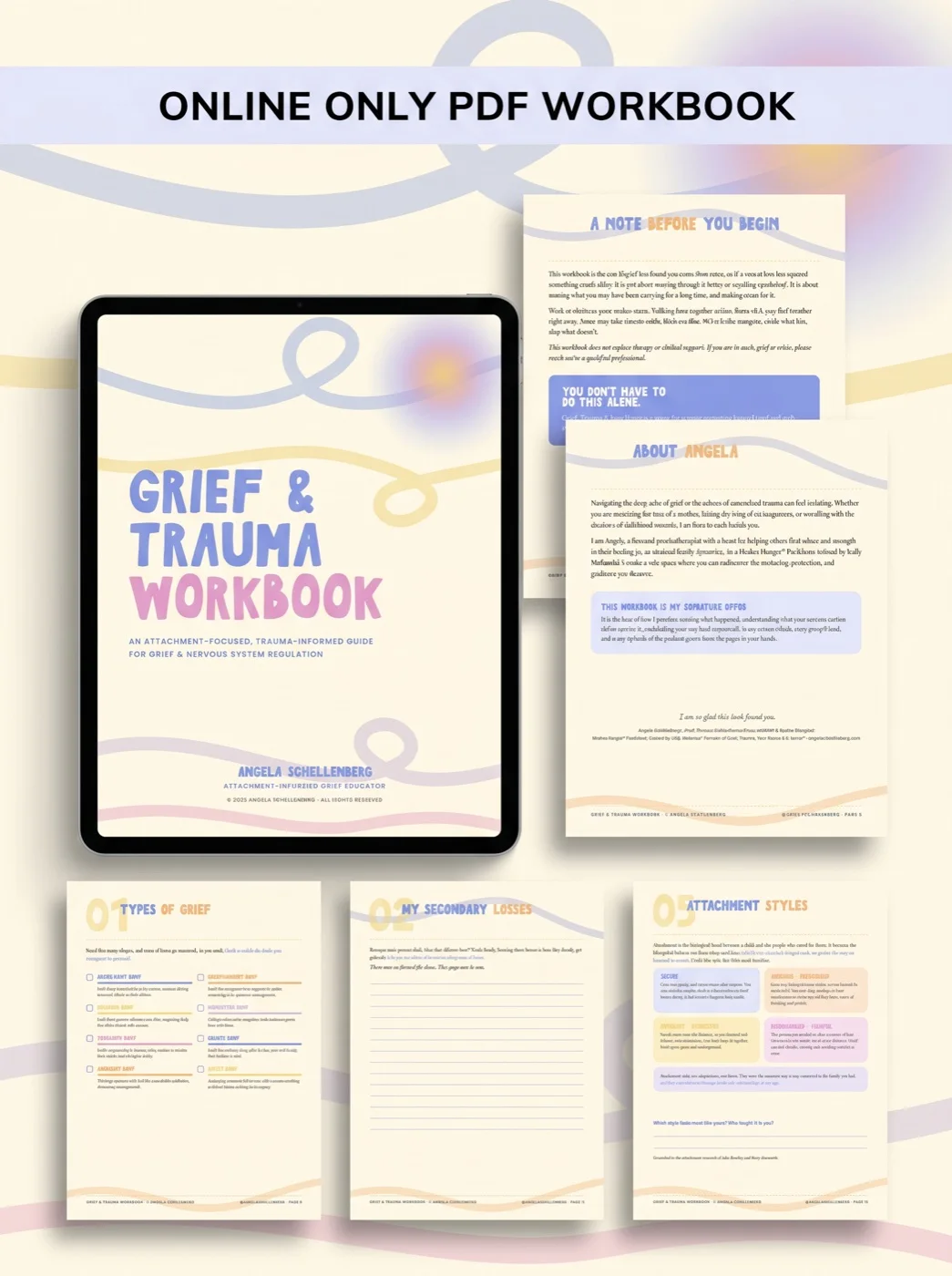
Pair it with the Grief & Trauma Workbook
Where this journal holds your brother or sister, the workbook holds your nervous system. Twenty-four kinds of grief, your attachment style, your trauma responses, and a printable values card deck. Many readers keep both on the nightstand.
See the workbookNot ready for the journal? Take this with you
Why Grief Keeps Coming Back is my free guide on why loss like this resurfaces long after everyone else thinks you should be done, and why that is not you going backward. Leave your name and email and I will send it.
Not sure where to begin?
Some women start in community, some want focused one-to-one support, some just need more time with the pages first. None of those are wrong. There is a free fifteen-minute call, if you want it.
Book a free 15-minute call