A Child Loss Grief Journal
Still Your Mother
for the love that does not endA 119-page guided journal for mothers grieving a child, of any age, lost any way. Twelve rooms you can wander in any order, written by a licensed grief and trauma therapist.
Grief is love with nowhere obvious to go. This gives it somewhere to go. Questions first? Ask Angela.
You carried them. You loved them. You are still their mother. That does not end.
There is no word for a mother who loses a child
A wife who loses a husband is a widow. A child who loses parents is an orphan. For you, the language just stops.
It stops because this is the loss the world cannot bear to look at, so it looks away. People cross the street. They stop saying your child’s name, thinking the silence spares you, when the silence is its own weight. And underneath it all sits the question nobody will answer out loud: am I still a mother? These pages answer it on the very first page. Yes. Nobody can take that from you.
Most grief journals cannot hold this
They are built for losses with edges: gentle prompts, five tidy stages, an arc that ends in acceptance. Child loss does not have edges. You needed room for the fog, the rage, the guilt, the 3am hours, the marked days, and the story itself, kept behind a clearly marked door you never have to open.
This journal was built for exactly that, and it never asks you to be further along than you are.
what this actually is
Twelve rooms you can wander, in any order
Think of the book as a house. Every room is here when you are ready for it, and no door locks behind you. Go in order, or open to whatever page matches the day.
You
Memory-keeping: who your child is.
Still Your Mother
The identity nobody can take.
The Grief
The fog, the waves, and why your brain does this.
The Body
What grief does in a body, and what steadies one.
The Rage
The anger, uncensored and uncorrected.
The Guilt
Met with company, not correction.
The Losing
The story, at your pace. Clearly marked, fully optional.
The Ones Who Remain
Partners, children, and the world around you.
The Marked Days
The birthday, the date, Mother’s Day, the silence.
Letters to You
The conversation continues.
What Continues
The bond that changes form.
A Year of Visits
Twelve undated visits, each with its own questions.
Pencil, pen, tears, coffee rings. All welcome. This is a working book, not a precious one.
the part no other journal can copy
Written by a therapist who has sat in this exact grief
Angela is a licensed grief and trauma therapist. So the book holds what other journals cannot.
A room for the story, behind a marked door
When the loss was traumatic, the story needs a room with a door, not a page you stumble onto. The Losing is clearly marked and fully optional, and the journal holds together whether you ever open it or not.
The attachment science of mother grief
A mother’s body organizes itself around her child. The journal names why the fog, the reaching, and the 3am hours are attachment doing what attachment does, not something gone wrong in you.
Somatic practices from the therapy room
These pages do not only ask you to write. They invite you to ground, to breathe, to tap, to walk. Your body did some of the loving. This journal lets it do some of the grieving.
A door to more, on the last page
When you finish your last letter to them and turn the page, there is a way to reach Angela directly, including a free fifteen-minute call, for the days a book is not quite enough.
What these pages will never do
No silver linings, and no "everything happens for a reason."
No timeline you are somehow failing.
No religion built in, so it holds whatever faith, or absence of faith, you bring.
No pressure to be done. Grief is not a problem to solve.
Give the love somewhere to go
Start tonight with the instant PDF. It will wait for you on the hard days and keep your words on the good ones.
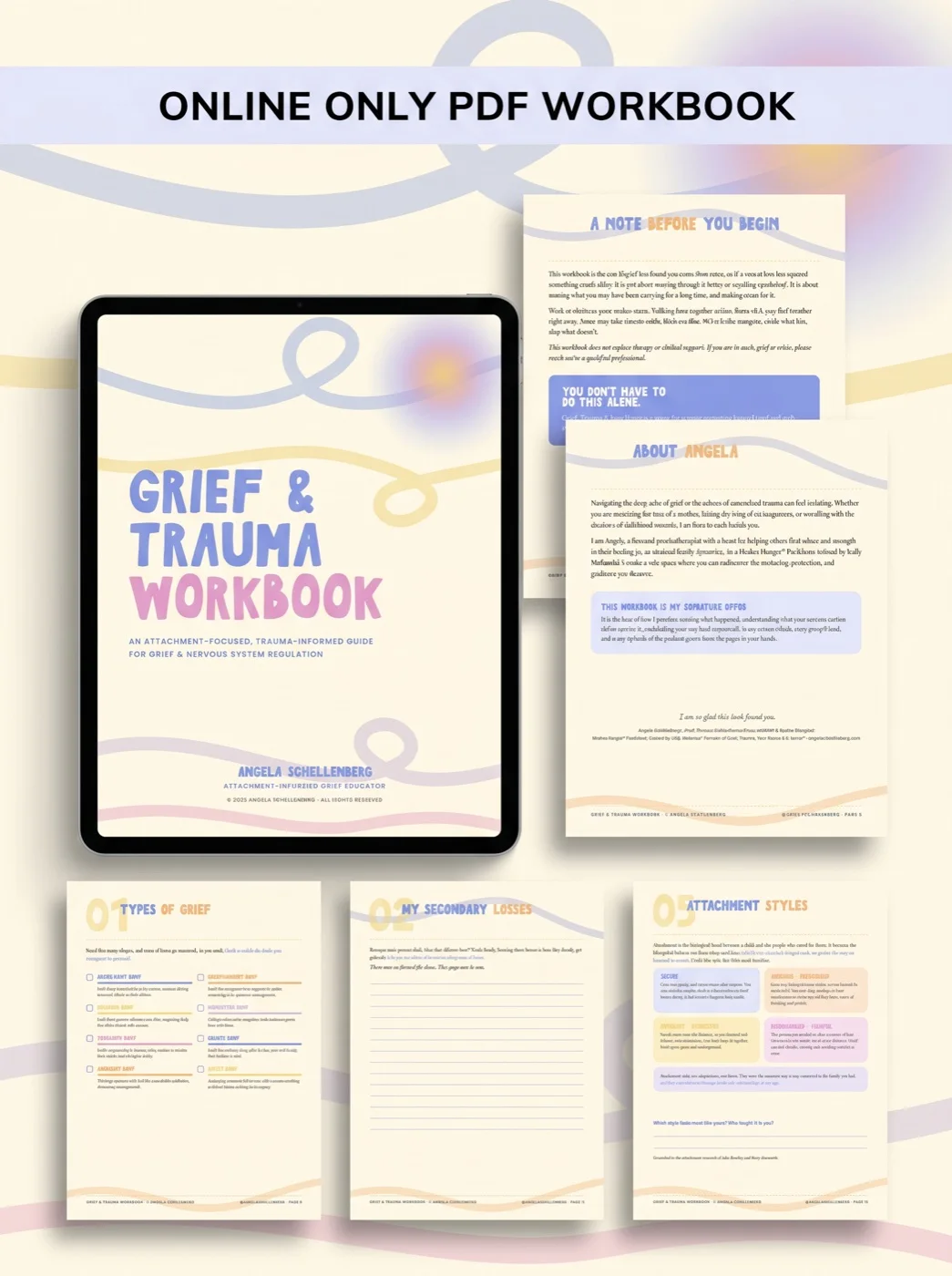
They belong together
Pair it with the Grief & Trauma Workbook
Where this journal holds your child, the workbook holds your nervous system. Twenty-four kinds of grief, your attachment style, your trauma responses, and a printable values card deck. Many readers keep both on the nightstand.
See the workbookNot ready for the journal? Take this with you
101 Distress Tolerance Tips is a printable list of small, concrete ways to steady your body when grief is loud. Leave your name and email and I will send it.
Not sure where to begin?
Some mothers start in community, some want focused one-to-one support, some just need more time with the pages first. None of those are wrong. There is a free fifteen-minute call, if you want it.
Book a free 15-minute call